
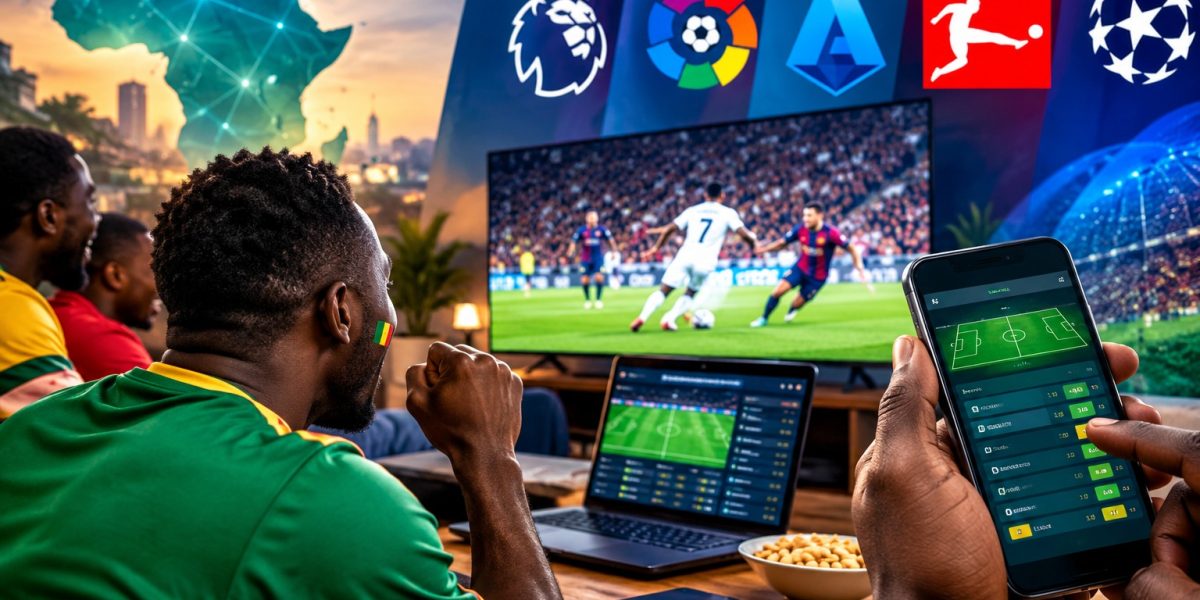
From Cape Town to Lagos, Accra and Nairobi, football talk fills viewing centres, homes and offices every weekend. Fans debate team selections, argue over referee decisions and keep tracking results long after the final whistle.
For millions of supporters across Africa, European football is a weekly routine shaped by smartphones, television, friendships and, for many, sports betting. Below, we look at which leagues have the strongest following on the continent and how fans keep up with them.
The Premier League’s Strong Following
The English Premier League (EPL) draws the most interest across Africa. In GeoPoll’s May 2026 survey of 2,452 people across five countries, 96% of respondents in Kenya and 91% in Nigeria said they watch and follow the EPL. The league also came out on top in Ghana and South Africa. Mozambique was the exception, where Spain’s La Liga was the most followed league.
Chelsea, Manchester United, Arsenal, Liverpool, Real Madrid and Barcelona have the biggest fan bases across African countries.
The UEFA Champions League brings fans of different domestic leagues together during the week. African players competing in Europe add another connection, so many supporters follow individual careers as closely as club rivalries.
Watching Matches and Staying Connected
Television is still the main way to watch European football. In most of sub-Saharan Africa, SuperSport holds the EPL broadcasting rights, while beIN Sports covers North Africa and the Middle East.
Depending on where they live, fans also watch at neighbourhood viewing centres, bars, licensed streaming services and free-to-air channels. GeoPoll found that South Africans, Ghanaians and Mozambicans mostly watch through pay television, while 64% of Nigerians rely on free-to-air broadcasts for live football.
Between matches, live score apps deliver results, highlights and team news. WhatsApp groups, social platforms and online football communities keep the conversation going all week, covering starting line-ups, injuries, transfer rumours and the latest controversies.
Fantasy Premier League (FPL) adds another layer. Players pick the footballers they expect to perform each gameweek, weigh form against upcoming fixtures, choose captains and time their chips. They compete in public leagues and in private leagues with friends and colleagues.
Kick-off times help too. Most top European matches are played on weekend afternoons or weekday evenings, when friends and family can get together and watch.
Betting Is Part of Matchday
Sports betting is popular in many African countries, and a large share of bets are placed on European fixtures. Mobile platforms make it easy to compare odds and bet before kick-off or live during the match. Fans who want to see which bookmakers are available in their country can find comparisons on sites such as https://topbets.africa.
GeoPoll’s June to July 2026 betting survey of 2,866 people in six African countries found that 95% placed bets on their mobile phones and 67% bet mostly on football.
Familiar markets explain much of football’s appeal for bettors: match result, total goals, both teams to score, double chance and corners. Some bettors prefer accumulators, while others stick to single-match bets.
Many bookmakers also work as information hubs, showing statistics, fixtures and live match updates. Still, supporting a big European club doesn’t make results predictable, and accumulators are always harder to win than single bets. Betting is best treated as entertainment, with a budget set in advance.