
The Confederation of African Football (CAF) has introduced comprehensive coaching qualification requirements for its continental club and national team competitions, establishing minimum licensing standards for head coaches and assistant coaches across senior and youth football.
The new framework sets different certification thresholds according to competition category, while introducing a mandatory female representation rule for technical benches in women’s competitions.
The regulations cover major tournaments, including the Africa Cup of Nations (AFCON), African Nations Championship (CHAN), CAF Champions League, CAF Confederation Cup, CAF Super Cup and various women’s and youth competitions.
Under the new requirements, coaches must possess the appropriate CAF licence or an equivalent qualification recognised by another confederation to be eligible for the relevant technical position.
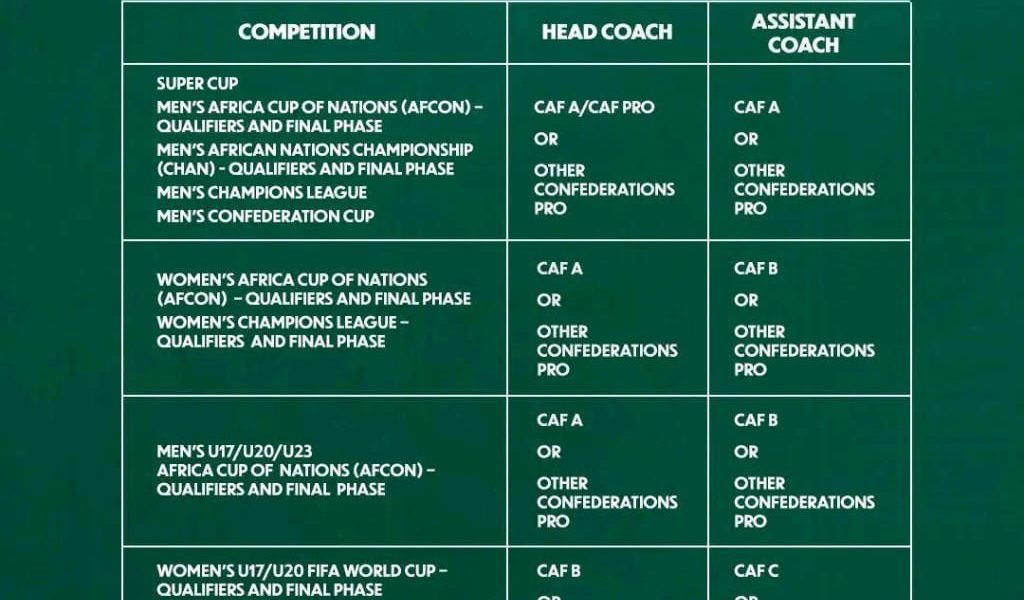
For senior men’s competitions, including AFCON, CHAN, the CAF Champions League, Confederation Cup and Super Cup, head coaches must hold a CAF A or CAF Pro licence, or a recognised Pro Licence issued by another confederation.
Assistant coaches must possess a CAF A licence or an equivalent Pro Licence from another confederation.
The requirements establish a minimum qualification threshold for technical leadership at the highest level of African men’s football, with clubs and national associations expected to appoint coaches who meet the prescribed standards.
CAF has also outlined specific licensing requirements for senior women’s tournaments and men’s youth competitions.
For the Women’s Africa Cup of Nations (WAFCON), the CAF Women’s Champions League and the men’s U17, U20 and U23 AFCON tournaments, head coaches must hold a CAF A licence or a recognised Pro Licence from another confederation.
Assistant coaches in these competitions must possess a CAF B licence or an equivalent Pro Licence from another confederation.
For women’s youth competitions, including U17 and U20 FIFA World Cup qualifiers and youth club tournaments, the requirements are lower but remain clearly defined.
Head coaches must hold a CAF B licence or a recognised A-level coaching qualification from another confederation, while assistant coaches must possess a CAF C licence or an equivalent A-level qualification from another confederation.
One of the key provisions of the new framework concerns female representation in women’s football.
CAF requires every team participating in its women’s competitions to have at least one woman serving in the primary technical leadership structure, either as head coach or assistant coach.
The measure establishes a formal requirement for women’s representation in coaching positions and is intended to strengthen female participation in technical leadership across the continent.
CAF has outlined transitional arrangements for coaches who do not yet meet the new qualification requirements.
Coaches working under valid contracts signed before the announcement will benefit from a two-season grace period covering the 2025/26 and 2026/27 seasons to obtain the necessary licences.
However, clubs and national associations recruiting new technical staff after the implementation date must ensure that their appointments meet the prescribed qualification standards from the outset. Newly appointed coaches will not be eligible for the transitional exemption.
Coaches who do not fall within the protected contractual arrangements are expected to comply with the applicable requirements immediately.
The regulations place greater responsibility on clubs and national football associations to verify coaching qualifications before making appointments for CAF competitions.
For clubs competing in continental tournaments, compliance will become an important consideration in technical recruitment, while national associations will need to ensure their coaching appointments meet the relevant standards across senior and youth teams.
The female representation requirement also introduces a specific staffing obligation for teams competing in women’s tournaments.
With the framework covering competitions across multiple levels of African football, CAF’s new standards establish a common qualification structure for technical personnel and set clear expectations for coaching appointments and professional development.
Note: The implementation dates and licensing provisions above reflect the supplied information. The official CAF circular should be consulted to confirm the precise effective date, recognition of equivalent licences and any competition-specific exceptions.