
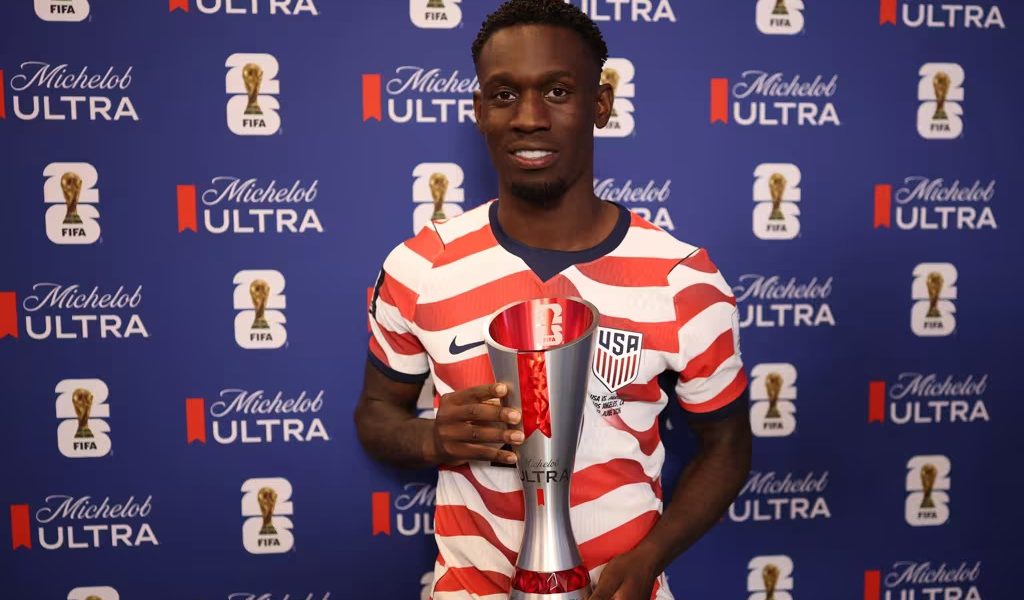
FIFA’s decision to withdraw the suspension of Folarin Balogun for the round of 16 World Cup game on Monday 6 July between USA and Belgium shocked the world of football. The decision is highly questioned, especially because several sources say that it was the result of a phone call between The White House and FIFA president Gianni Infantino.
COMPETITION REGULATIONS Striker Folarin Balogun was sent off on Wednesday 1 July in USA’s last-32 win over Bosnia-Herzegovina, when he caught Tarik Muharemovic with his studs on the ankle.
Following the FIFA World Cup 2026 Competition Regulations, as set out in article 10.5, he should miss the game against Belgium on Monday 6 July: “If a player or team official is sent off as a result of a direct or indirect red card (second caution), they will automatically be suspended from their team’s subsequent match. In addition, further sanctions may be imposed.” The suspension of Balogun was a big loss for the USA, as he scored three times in four games.
But on the morning of Sunday 5 July, FIFA came out with a statement that struck the world of football by surprise, saying that Balogun would not be suspended for the game against Belgium. FIFA based its decision on article 27 of the FIFA Disciplinary Code. This provision states that the FIFA Disciplinary Committee may decide to suspend the enforcement of a previously imposed disciplinary sanction.
BELGIUM REACTS The Royal Belgian Football Association (RBFA) reacted with a statement, saying it is astonished “by FIFA’s decision to declare suspended United States player Folarin Balogun eligible to play in the USA–Belgium match on Monday, 6 July”.
The RBFA stated that the decision was not only in contradiction with the FIFA World Cup Competition Regulations in article 10.5, but also with the article 66.4 of the FIFA Disciplinary Code, which “clearly provides that a red card (sending-off) automatically results in a suspension for the team’s next match, as has been the case for all previous red cards issued during this FIFA World Cup.”
In fact, in the case of the eleven red cards shown at this World Cup shown apart from the one for Balogun, no other case was reconsidered. And since the rule that a player with a red card is automatically suspended for the next game was implemented in 1970, not a single red card suspension was reconsidered at the World Cup.
PRESIDENT TRUMP’S POST Things got even more astonishing when Donald Trump posted on his social media: “Thank you to FIFA for doing what was right, and reversing a great injustice!”
Not much later, several sources, including ‘The New York Times’, said that Trump had made a phone call with FIFA president Gianni Infantino, asking to reconsider the red card of Balogun. It’s no public secret that Infantino and Trump have a close relationship, especially since Infantino awarded Trump the ‘FIFA Peace Prize’ on 5 December 2025.
LEGITIMATE RIGHTS
In its statement, the Belgian RBFA concluded: “In order to safeguard the legitimate rights of all participating teams and to protect the fundamental principles of fair play in our sport, both at this FIFA World Cup and at future editions of the tournament, the RBFA is investigating all potential options.”
Belgium shouldn’t be worried too much about the availability of Balogun for Monday’s game, after all he is no Lionel Messi or Erling Haaland. But a President of the United States interfering with sports, and especially with the biggest sports association in the world, is one of the biggest dangers in sports.
In the darkest days of FIFA, when the FBI invaded their headquarters in Zürich in 2015 and arrested members of the executive committee, the game as such was not threatened. But now, decisions are made with clear consequences on the pitch and on the game. Fair play and sports ethics are in danger. The decision on Balogun and the things that happened behind closed doors, undermine the foundations of sport.