
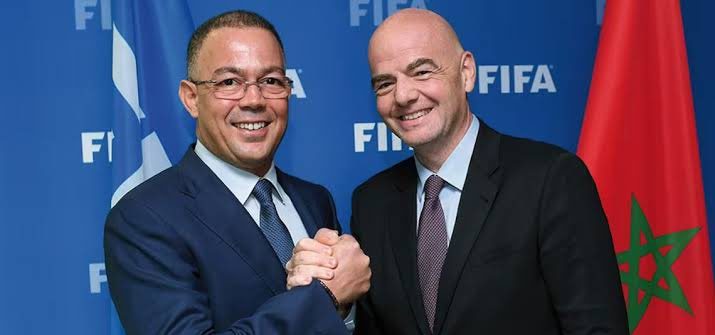
Four influential members of the Confederation of African Football (CAF) Executive Committee, who also sit on the FIFA Council, have publicly thrown their support behind FIFA president Gianni Infantino, offering a strong signal of where the continent’s football leadership currently stands.
Fouzi Lekjaa of Morocco, CAF’s First Vice President, alongside Mauritania FA president Ahmed Yahya, Djibouti FA president Souleiman Waberi, and Niger FA president Djibrilla Hamidou, have each issued statements backing Infantino. Their messages, originally delivered in French, underline a coordinated show of confidence in the embattled FIFA chief.
The declarations are being interpreted as a reflection of sentiment within CAF’s upper hierarchy, suggesting that Africa’s most powerful football figures are, at least for now, aligned in their support of Infantino.
Notably, other CAF vice presidents have remained silent on the matter, including Ghana Football Association president Kurt Okraku, whose absence from the public discourse has drawn attention given his prominent role within both CAF and FIFA structures.
Sources within African football circles indicate that the continent’s leadership remains politically supportive of Infantino, a stance that has not shifted in recent days despite mounting scrutiny around FIFA governance.
An official position from CAF is still expected, either through a formal written statement or via remarks from CAF president Patrice Motsepe. Such a declaration would clarify whether the current wave of individual endorsements reflects a unified continental position.
Africa, widely regarded as the second-largest voting bloc in global football politics, holds significant influence in FIFA decision-making. How that influence is exercised—whether in pursuit of the continent’s own strategic interests or in alignment with broader political alliances—remains a subject of ongoing debate.
For now, the backing from key CAF figures reinforces Infantino’s support base, but the broader continental stance, once formally articulated, could prove decisive in shaping the next phase of football’s political landscape.